

Dimensional Stabilization of Bearings
Why Temperature Affects More Than Just Lubrication
Bearings are highly precise components. Tolerances, internal clearance, raceway geometry and preload operate within the micrometer range. Accordingly, they react very sensitively to thermal influences. While lubrication and sealing solutions are often in focus, one critical factor is frequently underestimated: the dimensional stability of the bearing steel.
Limits of Standard Bearing Steel
Standard bearing steel is designed for continuous operating temperatures up to 120°C. Short term exposure up to approximately 150°C is permissible. Within this range, the bearing remains dimensionally stable and maintains the required tolerances. Once these temperatures are exceeded, the dimensions of the bearing begin to change. The reason lies in metallurgical effects resulting from the steel manufacturing and heat treatment process.
Heat Treatment and Its Consequences
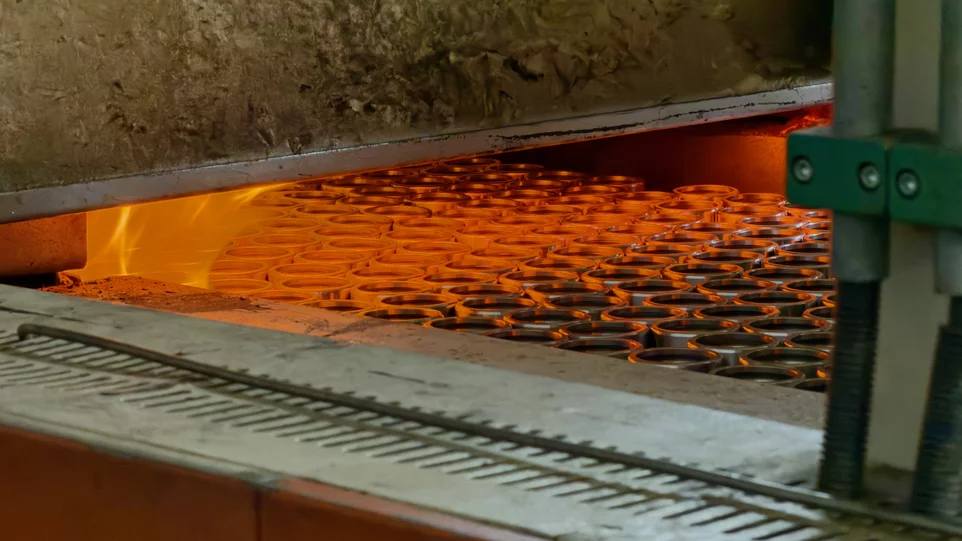
To achieve the required mechanical properties, bearing steel is hardened. After hardening, the material exhibits very high hardness but insufficient toughness. Therefore, it is subsequently tempered at approximately 180°C to restore toughness. This standard tempering process also defines the maximum permissible operating temperature of the steel. If this limit is exceeded, residual stresses from the hardening process are relieved, leading to shrinkage of the component. At the same time, retained austenite transforms, resulting in growth of the material. The actual dimensional change is therefore a combination of both effects. Since bearings require extremely tight tolerances, defined internal clearance, precise raceway geometry and accurate preload, these dimensional changes must be strictly avoided.
Dimensional Stabilization as a Solution
To design bearings for higher operating temperatures, the steel is tempered at elevated temperatures after hardening. This additional tempering process specifically reduces residual stresses and largely transforms retained austenite. As a result, the bearing remains dimensionally stable even under increased operating temperatures.
The disadvantage is that as the tempering temperature increases, the hardness of the steel decreases, which also reduces the load capacity of the bearing. Dimensional stabilization is therefore always a deliberate technical compromise between temperature resistance and load capacity.
Temperature Classes of Dimensionally Stabilized Bearings According to DIN 623
| Suffix | Heat stabilized up to | Load capacity reference value |
| SN | 120°C | 100% |
| S0 | 150°C | 90 - 100% |
| S1 | 200°C | 75 - 90% |
| S2 | 250°C | 60 - 75% |
| S3 | 300°C | 50 - 60% |
| S4 | 350°C | 45 - 50% |
Conclusion
Dimensional stabilization is not a special case but a mandatory requirement for bearings used in high temperature applications. If operating temperatures exceed 120°C, the dimensional stability of the bearing steel must be actively considered during the design phase.
At SKA®, this aspect is evaluated systematically. The objective is a bearing solution that remains dimensionally stable under real operating conditions while ensuring the required load capacity.
For more details: www.ska.swiss/en/products-solutions/product-details/dimensional-stability